
Dear students, writing short notes requires a distinct proficiency. A well-organised short note can yield more marks than an essay question, and a poorly composed, presented short note may not receive sufficient marks. We have provided a format for composing brief notes for your reference and comprehension. You are encouraged to utilise more resources on the same topic for deeper understanding.
General Pharmacology
- Plasma Half Life:
Synopsis:
- Introduction and definition
- Formula
- Diagram with explanation
- Correlation of plasma half-life with kinetics of elimination
- Drugs with long and short plasma half-life
- Clinical Importance
- Biological half-life
Introduction & Definition: The plasma half-life (denoted as t1/2) is an important pharmacokinetic parameter, defined as the duration (in terms of seconds, minutes, hours or days) required for the administered drug to decrease the plasma concentration by 50%.
Diagram: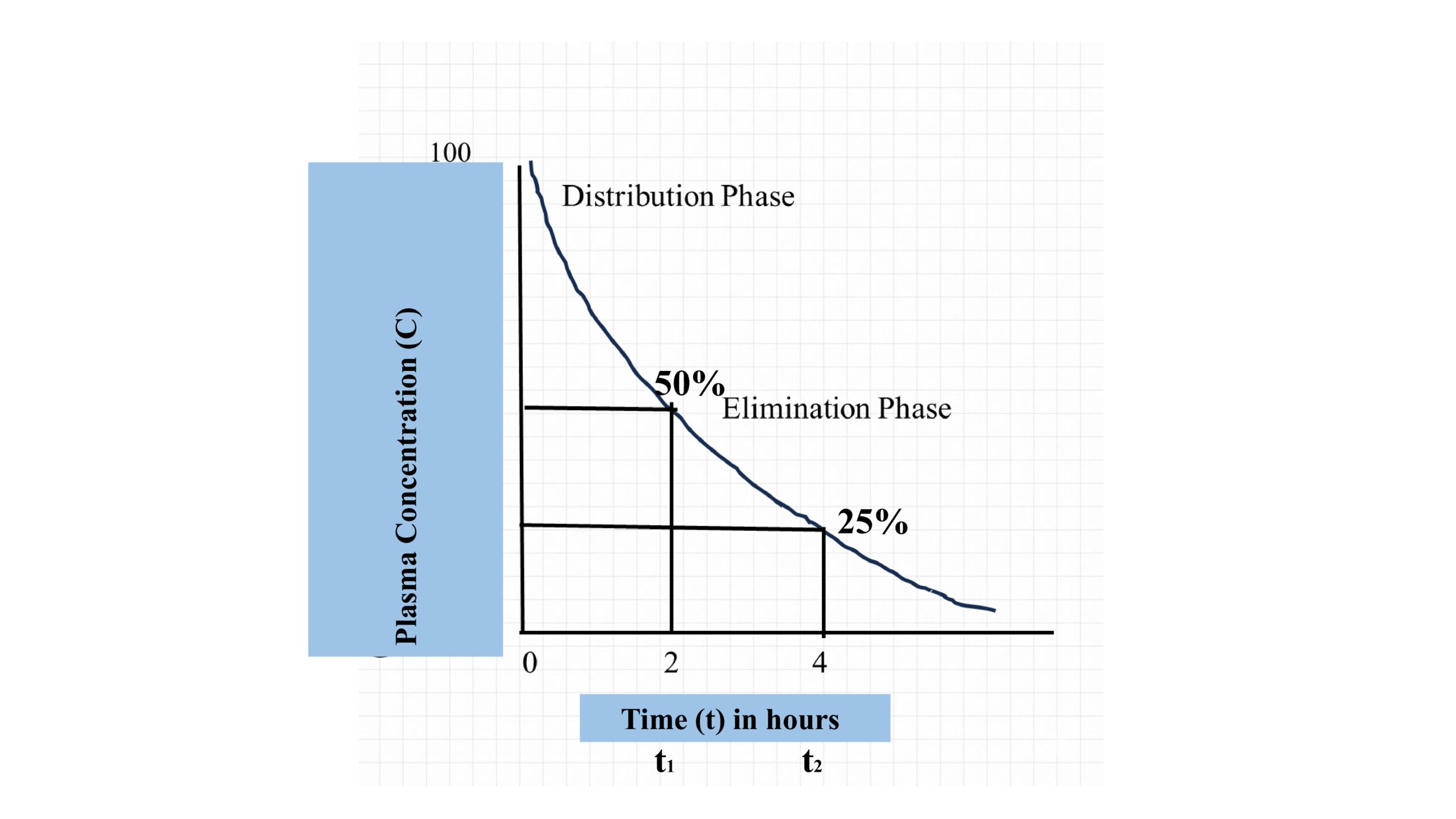
The plasma half-life is determined by administering a single intravenous dose and measuring the plasma concentration at fixed intervals. The above graph illustrates a phase of rapid decline in plasma concentration (Distribution Phase, resulting from the distribution of the drug into various compartments), followed by a steady decline in plasma concentration (Elimination Phase). Plasma half-life is calculated from the elimination phase using the following formula:
t1/2 = 0.693/k (k is elimination constant), k is CL/aVd, hence,
t1/2 = 0.693 X aVd / CL (CL=Clearance, AVd=Apparent volume of distribution)
The plasma half-life of the drugs mainly depends on the following factors:
- Plasma protein binding: drugs with high plasma protein binding have longer half-life as it takes a long time for elimination.
- Clearance: if the rate of clearance is fast, t1/2 is short and vice versa.
- Drug Reservoir: If a drug gets stored in tissues, it prolongs its elimination and thereby plasma- t1/2.
Correlation of plasma half-life with kinetics of elimination
- First-order kinetics: t1/2 is constant.
- Zero-order kinetics: t1/2 is variable
Examples of drugs with their plasma half-lives.
- Drugs with long plasma half-life are: Chloroquine (40 hours), Diazepam (40 hours), Digoxin (60 hours), Digitoxin (168 hours), Phenobarbitone (3-4 days), Amiodarone (25-60 days).
- Drugs with intermediate half-life: Paracetamol (2hours), Dexamethasone 4 hours), Quinine (11 hours).
- Drugs with short half-life: Norepinephrine (1-2 mins), Dopamine (5 mins), Dobutamine (2-3 mins) and Oxytocin (3-5 mins).
- Drugs with the shortest half-life: Adenosine (6 Sec).
Pharmacokinetic importance:
To eliminate 97% of the drug, it takes 4-5 plasma half-lives. Similarly, if the same dose of the drug is administered at a regular interval, then it takes 5 plasma half-lives to achieve a steady-state plasma concentration. In first-order kinetics, t1/2 is constant, while in zero-order kinetics, it is variable.
Clinical significance:
- Useful in a dosage regimen. The following table shows the plasma half-life of the drug and dosing frequency.
SL No. | Drug name | Plasma t1/2 | Dosing frequency |
1 | Adenosine | 6 seconds | IV bolus |
2 | Dopamine, Dobutamine | 2-5 mins | Infusion drip |
3 | Cefalexin, Paracetamol | 1 and 2 hours respectively | Every 6 hours |
4 | Lisinopril | 12 hours | Every 12 hours |
5 | Clarithromycin | 47 hours | Once a day |
- Drugs with longer t1/2 and high AVd take hours or days to achieve the desired concentration. In this situation, a loading dose is required for an early pharmacological response. In patients with heart failure, digoxin is administered as a loading dose followed by a maintenance dose, while Chloroquine is used as a loading dose in the treatment of Malaria.
- Plasma half-life is modified in renal and liver disorders; hence, dose adjustment is needed in patients with high t1/2.
- Drugs with the shortest t1/2, such as adenosine (Used for SVT), should be given as a rapid IV bolus for their desired pharmacological response.
- Drugs with more than 24 hours of t1/2, regular administration may cause cumulative toxicity, especially drugs with a narrow therapeutic index. Such drugs should be given intermittently to avoid drug toxicity. Example: Digoxin is administered 5 times a week instead of daily dosing.
Biological half-life: It is defined as the time required for the total amount of the drug to be reduced to 50 % during the elimination process (metabolism and excretion). It is rarely considered in clinical practice.
- Plasma Protein binding and its clinical significance:
Synopsis:
- Introduction
- Important protein that contributes to drug binding
- Plasma protein-binding drugs
- Clinical significance of plasma protein binding
- Clinically important displacement reactions
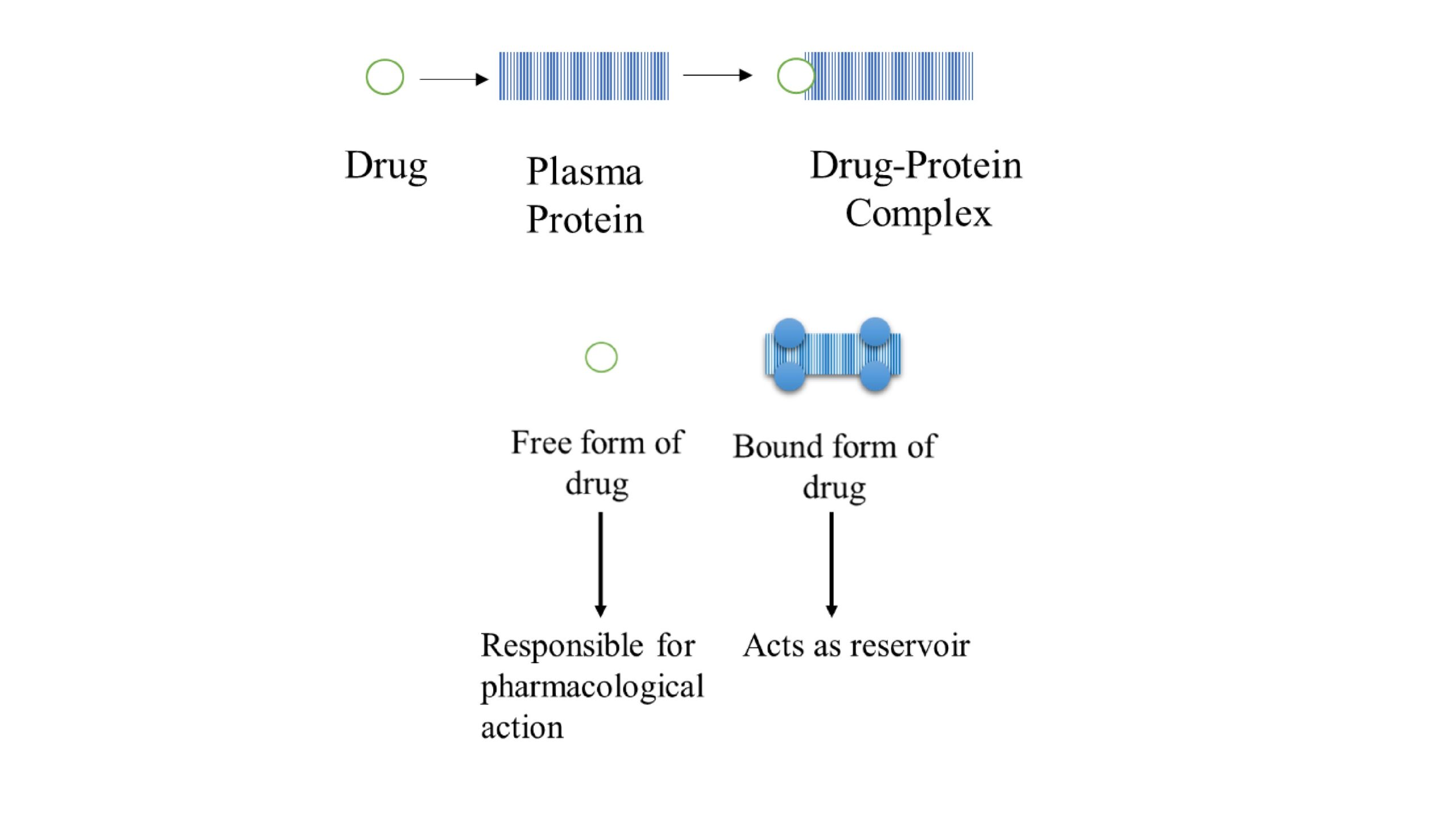
Introduction: Plasma protein binding is a key characteristic in drug distribution. Certain drugs can bind reversibly to major protein molecules such as albumin, globulins, tissue proteins and Alpha 1 acid glycoprotein, forming a drug-protein complex. The bound form of the drug is pharmacologically inactive, while the free or unbound form of the drug, in plasma, is responsible for the pharmacological action. The extent of binding influences the distribution and rate of metabolism of the drug.
Diagram:
Plasma protein binding drugs:
Acidic drugs bind to albumin (Example: Warfarin, Penicillin, Sulphonamides) while Basic drugs bind to acidic glycoproteins. (Example: Quinidine, Imipramine, Lignocaine, Propranolol). Drugs with a high volume of distribution (Vd), such as digoxin and emetine, bind to tissue proteins. Steroids, on the other hand, bind to transcortin.
Some examples of drugs with high plasma protein binding (more than 99%) include: Diazepam, Diclofenac sodium, Glimepiride, Ibuprofen, Amiodarone, and Ketorolac.
Clinical significance of protein binding:
- Drugs with high plasma protein-binding properties remain confined to the vascular compartment and will have a small Vd.
- Drugs with high protein binding will not be eliminated easily in case of overdose. Haemodialysis may be required to remove an excessive amount of the drug.
- The bound fraction of the drug is in equilibrium with the free form. When the concentration of free drugs goes down, the drug from the bound form is released for pharmacological action.
- In various disorders, the concentration of the free form of the drug varies, leading to treatment failure or toxicity. In Liver disease, uraemia, and hypoalbuminemia, there is reduced protein binding, causing an excess of the free form of the drug in plasma that causes cumulative toxicity even with a normal therapeutic dose. Patients with MI, Crohn’s disease, and inflammatory disorders exhibit elevated levels of Alpha 1 acid glycoproteins. Basic drugs, such as propranolol or quinidine, bind to alpha-1 acid glycoproteins, causing a decrease in the free portion of the drug and resulting in a lower pharmacological response at therapeutic doses.
- Protein binding depends on affinity. Hence, drugs with a higher binding potential get linked to plasma proteins more strongly and displace other drugs, leading to displacement reactions.
Clinically important displacement reactions
Clinically notable displacement reactions are stated here.
Drug 1 | Drug 2 | Displacement reactions | Outcome |
Sulphonamides | Tolbutamide | Sulphonamide displaces tolbutamide | Hypoglycaemia |
Phenytoin, Tolbutamide | Warfarin | Displacement of warfarin | Bleeding |
Sulphonamides | Bilirubin | Bilirubin displacement | Kernicterus in neonates |
- Teratogenicity:
Synopsis:
- Introduction and definition:
- Placental barrier and mechanism of teratogenicity
- Impact of the drug on various stages of pregnancy
- Examples of teratogenic drugs
- FDA classification and drugs that can be safely used in pregnancy
- General precautions while prescribing drugs during pregnancy
- Drugs that can be prescribed safely
Introduction and definition: Teratogenicity relates to developmental toxicities or birth defects in newborns when a drug is administered to a pregnant mother. A drug that interferes with the physiological growth of an embryo is called as a teratogen. The word “teratogen” originated from the Greek word meaning monster. Now the definition has been broadened to include birth defects at any stage of pregnancy, at birth or even developed after a later stage of life.
Placental barrier: separates the maternal and foetal blood vessels. The placental barrier, like the blood-brain barrier, cannot prevent the transport of most drugs, but it limits the exchange of toxic molecules from maternal to fetal blood. In general, highly Lipid-soluble drugs cross the placental barrier, enter fetal circulation, and produce deleterious effects on the foetus. However, polar substances (d-tubocurarine) or high-molecular-weight drugs (Insulin) do not affect the foetus, as they are unable to cross the placental membrane. Drugs can interfere with cell division, disrupt folate metabolism, increase oxidative stress or induce direct injury to developing structures.
Impact of drugs on various stages of pregnancy: The drugs received during pregnancy may induce harmful effects on the foetus. The impact of the drug mainly depends on the nature and type of medication, dose, route of administration and duration and timing of exposure during pregnancy. The drug may induce its toxic effect from the stage of blastocyst formation to the delivery of the newborn baby.
Different stages of pregnancy are:
Pregnancy Stage | Duration | The drugs causing teratogenic effects |
Blastocyst Formation | up to 2 weeks, spanning from conception to implantation | Anticancer drugs: harm the embryo-Abortions. |
Embryonic stage (Organogenesis) | 3-8 weeks | The major effect is Congenital malformations. (E.g. carbamazepine-Neural tube defects.) |
Fetal Stage (Organ development) | 9 weeks-40 weeks | No major congenital disorders, stunted organ growth. E.g. Tetracycline: Staining of teeth due to the retardation of enamel growth. |
Labour | Induction of labour till the delivery of the baby | Direct effect on the baby. E.g. Respiratory depression caused by Morphine. |
Examples of teratogenic drugs: Some of the notable examples of teratogenic drugs are as follows.
Drug | Therapeutic use | Teratogenic effect observed |
Thalidomide | Lepra reactions, SLE | Phocomelia |
Valproic Acid | Seizure disorders | Neural tube defect |
Methotrexate | Psoriasis, RA, Cancer | Limb malformation |
Topiramate | Seizure disorders, Migraine Prophylaxis | Cleft Lip and Cleft Palate |
FDA pregnancy risk categories and drugs that can be used safely during pregnancy: Almost all the drugs are contraindicated in the first trimester, while some of the drugs can be used during the second and third trimester. The FDA has mentioned the risk category for the drugs used during pregnancy, which is as follows.
FDA Classification | Risk | Example of a drug |
Category A | No risk in controlled human studies | Folic acid |
Category B | No confirmatory evidence of risk in humans. | Metronidazole |
Category C | Risk cannot be ruled out. | Amoxicillin |
Category E | Possible evidence of risk. | Valproic Acid |
Category X | Absolute contraindication, Confirmed risk. | Methotrexate, Topiramate |
General precautions while prescribing drugs during pregnancy:
- Avoid all drugs in the first trimester unless there is a dire emergency. Assess the risk-benefit and then use the lowest dose.
- Try non-pharmacological therapies before prescribing allopathic medications.
- Use a drug that has been proven safe during pregnancy.
- Prescribe medication to pregnant women using the new pregnancy and lactation labelling rule (PLLR).
- Prescribe folic acid to all pregnant women.
Examples of some specific disorders and drugs that can be used safely during pregnancy:
- Morning sickness: Meclizine, Doxylamine.
- Pulmonary TB: Rifampicin, Isoniazid and Ethambutol.
- Allergic rhinitis: Diphenhydramine.
- Bronchial Asthma: inhaled steroids and Beta 2 agonists.
- Hypertension: Alpha-methyl dopa, Labetalol.
- Fever: Paracetamol.
- Kinetics of Elimination
Synopsis
- Routes of drug elimination
- Clearance and hepatic extraction ratio
- First-order kinetics
- Zero-order kinetics
- Mixed order kinetics
- Importance of the kinetics of elimination
Routes of drug elimination: After the drug has induced its action, the systemically absorbed form of the drug or its metabolite is eliminated from the body through the kidneys or other excretory routes such as faeces, skin, lungs, saliva, and milk. The kinetics of elimination is about the rate of elimination of the drug. During the elimination phase drug follows first-order, zero-order or mixed-order kinetics. The maximum number of drugs follow first-order kinetics.
Clearance: Clearance is the ratio of the rate of elimination to plasma concentration of the drug, depicted by CL. Total clearance is considered the sum of renal and hepatic clearance.
Hepatic Extraction ratio: it is the fraction of drug that is removed by the liver, serves good indicator of drug elimination.
First-order kinetics (FOK): a fixed percentage of the drug is removed in each time interval. (remember F for first order and f for fraction)
Zero-order kinetics: a constant amount of drug is eliminated in each time interval.
Comparison between first-order kinetics and zero-order kinetics:
Criteria | FOK | ZOK |
Elimination per unit time | Fixed percentage | Fixed amount |
Type of kinetics | Linear kinetics | Non-linear kinetics |
Relationship with plasma half-life | Constant | Variable |
Relationship with CL | Constant | Variable (more with low concentration and vice versa) |
Relationship with plasma concentration | The rate of elimination is directly proportional to plasma concentration | The rate of elimination is not dependent on plasma concentration |
Drugs following kinetics | 95% of drugs | Remaining 5 %, Alcohol, Phenytoin, Aspirin, with high doses. |
If drug A follows first-order kinetics with an elimination rate of 30% (Fixed percentage) and its initial plasma concentration is 100 mg, then 30 mg of the drug will be excreted per unit time.
Similarly, if drug A follows zero-order kinetics with elimination of 40 mg (fixed amount) per unit time and its initial plasma concentration is 100 mg, 40 mg will be eliminated, and 60 mg will be accumulated in the body.
Mixed ordered kinetics: drugs like phenytoin, warfarin, tolbutamide, aspirin, and digoxin follow mixed order kinetics. It is non-linear kinetics, also known as Michaelis-Menten Kinetics, saturation kinetics or dose-dependent kinetics.
At initial lower doses, a constant fraction of the drug is eliminated (Drug follows FOK). When the dose exceeds, and the plasma concentration reaches the highest level, a constant amount of drug is eliminated. (Drug follows zero-order kinetics) This happens because of the saturation of the metabolising enzyme at higher concentrations.
Clinical importance:
- Prediction of steady state plasma concentration: As t ½ is constant in FOK, it takes 5 t ½ to reach the steady state plasma concentration.
- Therapeutic drug monitoring: it is better to do therapeutic drug monitoring of the drugs who follows zero order kinetics and have a narrow therapeutic index (Phenytoin).
- Management of Drug overdose: drugs that follows first order kinetics are comparatively easy to manage in case of poisoning, while in zero-order kinetics, elimination is slow, leading to cumulative toxicity. So, the primary aim is to adopt methods that will enhance the elimination process.